From APIs to Information: Rethinking Enterprise Intelligence in SAP Landscapes


Overview
This blog explores a shift underway across SAP landscapes from API-driven integration to information-driven architecture.
As access becomes more governed, organizations are rethinking how data is consumed and how analytics and AI are built at scale, moving away from continuous API dependency toward structured, reliable data flows.
At its core, this perspective reframes the change as an architectural opportunity.
It outlines how SAP continues to serve as a stable system of record, while data platforms and intelligence layers evolve independently enabling more scalable, flexible, and future-ready enterprise solutions.
The Business Context
Enterprise transformation today is not about digitization alone. It is about how organizations build, scale, and operationalize intelligence across their business.
The outcomes are already measurable.
Manufacturing firms are reducing unplanned downtime by 20–30% through predictive models. Supply chain organizations are improving forecast accuracy and responsiveness. Financial institutions are shortening reporting cycles significantly.
At the center of these gains lies a simple dependency, access to operational data.
For most enterprises, that data resides in SAP. Across ECC, RISE, and GROW environments, SAP continues to operate as the system of record, supporting transactions, enforcing compliance, and anchoring enterprise operations.
Over time, analytics and AI have been layered on top of this foundation, with the assumption of continuous and flexible data access.
That assumption is now shifting.
A Structural Shift in Access
SAP’s evolving API policy introduces a controlled model for system interaction.
Access is increasingly restricted to published APIs, with explicit limits around scale, automation, and data movement. Large-scale extraction and AI-driven orchestration, once common, now operate within clearer boundaries.
This is not a restriction on data ownership.
It is a constraint on how that data can be accessed at scale.
The implication is architectural. Integration is no longer just a technical consideration; it is now a design decision that directly affects how intelligence can be built and scaled.
Where the Impact Becomes Real
In large SAP environments, this shift is already visible.
Organizations manage hundreds of integrations and multiple pipelines, many dependent on continuous API access. As governance tightens, these dependencies become harder to sustain.
Manufacturing offers a clear illustration.
A predictive maintenance setup typically relies on real-time SAP data-equipment signals, production metrics, and operational events flowing continuously into external models. Under a governed model, this approach becomes less practical.
In response, organizations are restructuring data flows. Instead of continuous extraction, data is captured in structured intervals. Production outputs, logs, and operational snapshots are consolidated and processed outside SAP.
The outcome is not reduced capability. Predictive models continue to deliver above 90% accuracy. At the same time, API dependency drops by 40% or more, and integration complexity reduces by roughly 30%.
The insight is simple: real-time access is often less critical than reliable access.
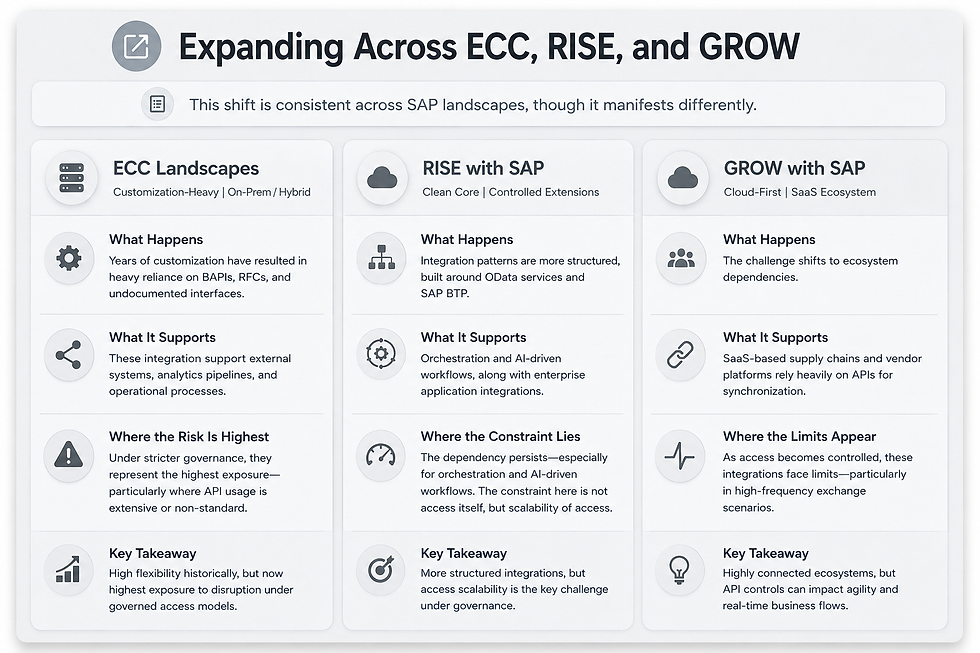
Expanding Across ECC, RISE, and GROW (From APIs to Information: Rethinking Enterprise Intelligence in SAP Landscapes)
To understand the full impact, it is important to look at how APIs are used across different SAP landscapes and where constraints begin to surface.
A New Architectural Baseline: From APIs to Information Flows
(From APIs to Information: Rethinking Enterprise Intelligence in SAP Landscapes)
Traditional SAP architectures are built around continuous API interaction. Systems pull data in real time to support analytics and decision-making. This works at smaller scales but becomes fragile as usage grows and governance tightens.
What is emerging instead is a shift toward information flows.
Data is no longer continuously pulled. It is structured, extracted, and consumed deliberately—through reports, scheduled pipelines, and controlled data replication. What was once a secondary approach is now becoming the primary foundation for analytics and AI.
This shift reshapes architecture as shown in the below image.
The SAP Core remains focused on transactional integrity, compliance, and operational stability
The Data Extraction and Integration layer reduces API dependency by moving toward structured, controlled data flows
The Enterprise Data Platform becomes the central aggregation and processing layer, improving data availability and scalability
The Intelligence / AI layer operates on consolidated data to generate insights, forecasts, and decisions
The Experience & Innovation layer delivers applications, copilots, and automated actions—independent of core system constraints
This layered separation enables each part of the architecture to evolve independently.
API dependency reduces by 30–50%. Data availability improves by 25–40%. Analytics and AI scale without increasing pressure on SAP systems.
The shift is not from APIs to none. It is from API-driven architecture to information-driven architecture.
Evaluating the Path Forward
As organizations respond, the path forward is not singular. It is a combination of approaches, each suited to specific needs.
No single model fully addresses compliance, performance, and innovation together. Organizations that approach this as a portfolio decision, rather than a binary choice are better positioned to balance stability with flexibility.
Approach | Role | KPI Impact | Strength | Limitation |
SAP-Centric (BTP) | Core + extensions | High compliance | Stable | High dependency |
Controlled APIs | Real-time execution | Sub-second response | Critical for operations | Coupled architecture |
Data Replication | Analytics pipelines | 20–40% faster insights | Scalable | Cost overhead |
Report-Driven | Primary ingestion | Covers 60–70% use cases | Simple | Not real-time |
Sidecar Layer | AI & innovation | 30–50% faster innovation | Flexible | Requires architectural shift |
This trade-off becomes more visible when evaluating AI adoption.
SAP-native AI solutions often scale into significant investments over time, tied to ecosystem dependencies. External AI platforms offer greater flexibility, faster experimentation cycles, and broader integration capabilities.
As a result, many organizations are moving intelligence layers outside SAP, while retaining SAP as the system of record.
What to Do and What to Avoid
As architectures evolve, the difference between resilient and fragile systems becomes clearer.
The focus shifts toward building scalable data foundations, separating intelligence from transactional systems, and adopting a hybrid approach. At the same time, common risks emerge from over-reliance on a single model.
What to Do | Why It Matters | What to Avoid | Risk Introduced |
Prioritize data usability over integration depth | Enables scalable analytics | API-heavy redesigns | Fragile architectures |
Build structured data pipelines | Supports majority of use cases | Assuming real-time always required | Complexity overhead |
Separate intelligence from SAP core | Enables independent scaling | Embedding innovation in SAP | Reduced agility |
Adopt hybrid architecture | Balances control and flexibility | Single-model dependency | Limited scalability |
Use APIs selectively (20–30%) | Preserves critical performance | Treating APIs as default | Governance bottlenecks |
Externalize innovation | Accelerates experimentation | Tightly coupled systems | Long-term rigidity |
The goal is not to eliminate Apis. It is to ensure that intelligence does not depend on them.
Closing Perspective
This shift is not a limitation. It is a design signal.
It reflects a move toward stable systems of record and independent intelligence layers.
SAP continues to anchor operations, but it no longer defines the boundary of innovation.
Organizations that succeed will build flexibility around SAP not deeper dependency within it.
Where Acclero Comes In
At Acclero, the focus is not just on technology—it is on outcomes.
We help organizations:
Reduce SAP dependency by 30–50%
Accelerate AI initiatives by 25–40%
Build scalable sidecar architectures
Because the objective is not to replace SAP.
It is to ensure that innovation is never constrained by it.
For more details, contact us at


Comments