From Frozen Systems to Fresh Agents

Unlocking Canada’s Food Supply with a Leaner ERP + Agentic Side Car Apps
Canada’s food production engine - stretching from Atlantic seafood processors to Ontario nut roasters, Prairie meat and dairy producers, and hundreds of raw‑material suppliers - runs remarkably hard.
It is the country’s largest manufacturing sector by output, responsible for $173.4B in goods in 2024 and more than 318,400 jobs, while buying over half of Canada’s agricultural production.
But behind this powerhouse lies a quieter constraint: many of these companies still rely on heavily customized SAP ECC systems, built over decades and now struggling under the weight of new regulations, volatile markets, and rising global shocks.
Today’s food leaders are not just fighting inflation or supply chain congestion — they are fighting their own systems as well!
And the good news?
A leaner ERP approach, powered by clean‑core principles, sidecar innovation, and responsible AI Agents, is emerging as the fresh re-start the industry needs!
Where the Freeze Begins: The ECC Bottleneck
For years, on-premise SAP ECC has been the reliable brain of Canadian food operations — the de facto ERP running MM, PP, SD, FI/CO, warehouse movements, quality inspections, trade spend, and batch manufacturing.
But decades of custom code, add‑ons, and one‑off workflows have turned many ECC estates into rigid, high‑maintenance systems.
This rigidity matters more than ever now, because 2026 has brought with it a number of external factors such as...
Demand volatility and cost swings from skyrocketing cocoa and elevated cattle prices to soften consumer spending.
Trade and tariff risks, with manufacturers pausing capital projects amid uncertainty.
Port strikes & logistics shocks disrupting grain, seafood, and packaged food exports, costing tens of millions per day.
Compliance pressures, with SFCR traceability and CFIA allergen labeling requiring accurate, audit‑ready process controls.
And then last straw, A firm SAP deadline, mainstream ECC support ends December 31, 2027, with costly extended maintenance only until 2030 and after that no support for SAP ECC.
ECC was never built for this pace of change.
Each new regulation, label change, or supply shock collides with a core that can't move quickly, making operations feel frozen even while the business moves at full speed.
The Challenges Playing Out Across the Sector
Across seafood processors, snack/nut manufacturers, meat and dairy producers, and specialty food operations, leaders consistently report the same symptoms: Slow upgrades, brittle integrations, manual workarounds, and difficulty keeping pace with political, compliance, and tariff-driven demands.
Operational & Scalability Strain
Overloaded ECC cores slow batch processing, MRP runs, and plant-floor integrations.
High-export segments like seafood—where up to 86% of production is export dependent—feel the strain first when systems cannot respond quickly.
Political & Tariff Pressures
Tariff shifts and evolving trade conditions between Canada and global markets introduce sudden procurement and planning shocks.
Legacy ERPs struggle to re-route supply chains or adjust vendor flows when geopolitical conditions change.
Economic & Margin Pressure
Volatile commodity prices (cocoa, cattle, grains) and retailer expectations require near real time visibility that old ECC reporting pipelines cannot deliver.
Rising input costs—including labor, packaging materials, energy, and transportation—are putting additional pressure on margins, requiring faster cost‑to‑serve visibility than ECC can provide.
The Aspiration: A Leaner, More Insightful ERP with Agentic Side Car Apps

What food companies want
Canadian food companies want one thing above all: an ERP foundation that is fast, clean, predictable, and ready for continuous change. But many organizations are still held back by a bloated ECC core—a system that has become too slow, too fragile, and too complex to support the pace of today’s regulatory, political, and operational realities. They want...
Real‑time visibility across plants, suppliers, and logistics.
Compliance agility to respond quickly to SFCR, CFIA, and export documentation changes.
Standardized and governed processes rather than plant‑specific customizations.
A smooth, low‑risk path to S/4HANA (or any other system of record) instead of another high‑effort rebuild.
How a bloated ERP blocks this vision
A heavily customized ECC system—with layers of custom code, one‑off integrations, and spreadsheet‑driven logic—creates challenges that directly oppose these goals. These include...
Slow system changes: Every update or enhancement risks breaking custom logic.
Poor compliance responsiveness: Regulatory updates must pass through rigid, technical layers.
Weak tariff and trade adaptability: Supply‑chain shifts require agility the system cannot deliver.
Fragmented visibility: Over‑engineered reports and outdated data flows delay decision‑making.
Lack of standardization: Each site operates differently because custom code has hard‑wired variations.
How Clean Core + Sidecar Apps Unlock Agility : From Frozen Systems to Fresh Agents
The modernization pattern gaining traction across Canada is simple but powerful:
1. Clean the core and Move innovation to “sidecars”
Stop adding new Z‑customizations and use ATC-based assessment to identify what can be retired or refactored. Tools like SAP’s clean‑core frameworks help quantify code of debt and risk.
In short, Instead of forcing new logic into ECC, build quick, modular applications for requirements such as...
SFCR traceability
Allergen & label governance
Catch certificates & QA workflows
Planning resilience dashboards
These run outside ECC but integrate seamlessly removing load from the core while enabling fast iteration.
Read more on this approach here: Don’t Fatten the Fat Boy : Power Platform for Clean Core SAP ECC
2. Start with Small Bets that make a Big Impact
Modern transformation doesn’t begin with massive multi‑year programs-it begins with small, high‑leverage bets that prove value quickly.
In every Canadian food manufacturer, countless micro‑processes—approvals, validations, sourcing checks, quality steps, vendor interactions-look small on paper but collectively shape throughput, compliance, and cost.
Across Canada’s supply chain landscape, procurement, quality, logistics, and compliance processes often operate in fragmented systems or email-driven workflows.
Even tiny delays multiply fast, especially in an industry already pressured by price volatility, labor challenges, and regulatory demands.
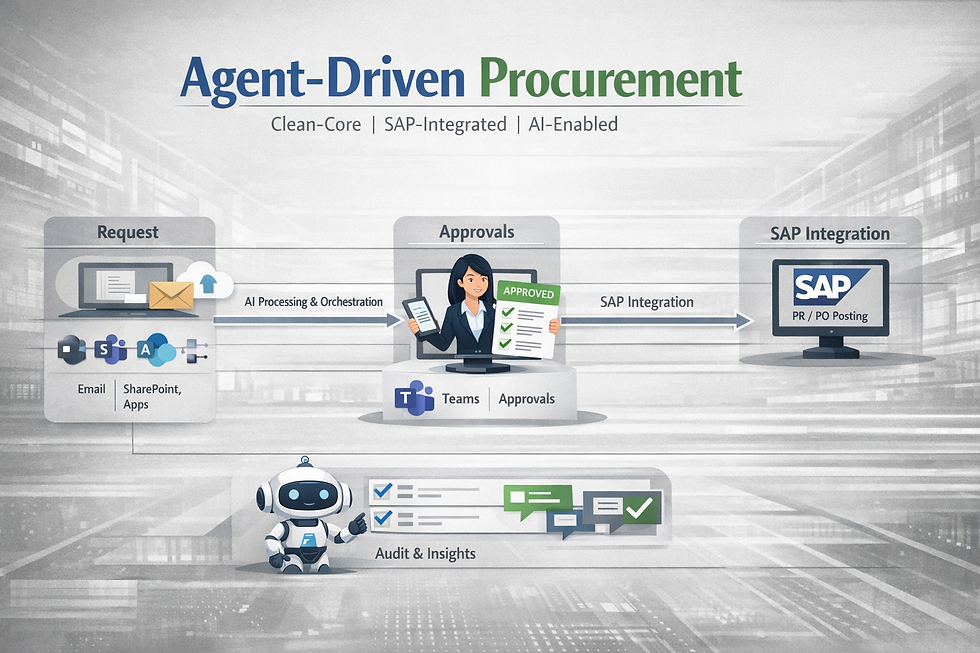
An example of such an Agentic AI Side Car App is Agentic Procurement. Read more about it here : AI Driven Procurement Demo with Clean Core SAP
This is why sidecar applications + agentic workflows matter: they target small friction points but unlock disproportionate impact. It is how organizations move from firefighting to foresight.
A leaner ERP—with a clean core, standardized processes, and intelligence delivered through side car Apps and AI agents—is what the Canadian food industry needs next.
Clean Core + Sidecar Agentic AI Apps Examples for Canadian Food Industry: The Fresh re-start we all look forward to

Let's look at the key ERP mega processes and how sidecar Agentic AI Apps strengthen each one - highlighting what’s broken, how sidecar AI apps fix it - with simple real world examples.
Farm‑to‑Forecast (Demand & Supply Planning)
Food producers must constantly anticipate the unpredictable—weather swings, retail promotions, commodity fluctuations, and shifting consumer behaviour.
ECC’s slow forecasting cycles and rigid planning screens make it difficult for planners to react quickly or run simulations.
This is where sidecar intelligence changes the game. By running forecasting logic outside the ERP and feeding only clean results back in, planners finally gain the agility they’ve been missing.
Some examples
Seasonal Demand Optimizer – Simulates weekly and seasonal demand variations using AI.
Promotion Lift Simulator – Evaluates retailer promotion impact and adjusts demand plans.
Commodity Volatility Sentinel – Watches global commodity indicators and triggers planning adjustments.
Source‑to‑Plant (Procurement & Supplier Collaboration)
Procurement sits at the frontline of risk—supplier delays, incomplete COAs, missing SFCR/allergen documentation, and global ingredient instability.
ECC workflows often slow things down because they depend on custom code or email-based approvals.
Sidecars modernize this space by acting as a supplier‑facing workspace and governance layer without touching the ERP core.
Few examples
Supplier Compliance Intake Hub – Captures SFCR, allergen, sustainability documentation in one workflow.
COA Intelligence Checker – Automatically validates COAs and delivery confirmations.
Ingredient Risk Radar – Flags risk in global ingredient supply like grains, spices, or imported fish.
Plan‑to‑Produce (Food Manufacturing & Scheduling)
Production scheduling in food manufacturing is complex: allergen segregation, sanitation cycles, shelf‑life, labour constraints, and energy availability must all align.
ECC enhancements struggle to balance these variables at speed.
Sidecars introduce simulation, optimisation, and constraint modelling without burdening the ERP.
Examples below
Energy‑Aware Production Scheduler – Uses dynamic energy availability to recommend optimal batch timing.
Allergen‑Smart Sequence Planner – Builds production runs that reduce sanitation resets.
Expiry‑Risk Prioritizer – Reorders production based on shelf‑life exposure.
Quality, Traceability & Compliance
Compliance workloads continue to grow: CFIA, SFCR, HACCP, export regulations, and retailer audit all demand precise documentation. ECC QM customizations often lag these demands.
Sidecars step in as dynamic, audit-ready systems that pull data from ERP but maintain the agility compliance teams need.
Below are some examples
Export Certificate Assistant – Auto‑generates export documents, traceability chains, and audit-ready bundles.
One‑Click Traceability Explorer – Retrieves full backward/forward lot genealogy.
Allergen & Label Governance Centre – Ensures consistent nutrition/allergen label data.
Plant‑to‑Distribution (Logistics & Cold‑Chain Execution)
Canada’s cold‑chain logistics are unforgiving.
Dock scheduling, frozen/chilled transport, retailer ASN expectations, and export timelines all require near real‑time decisioning. ECC’s static logistics screens cannot keep up.
Sidecars bring optimization and exception visibility without altering core SAP TM or WM processes
Here are some examples
Cold‑Chain Dock Slot Optimizer – Suggests optimal loading/unloading windows.
Temperature Deviation Watcher – Flags risk in chilled and frozen transport.
Retail ASN Exception Detector – Highlights mismatches before retailer penalties occur.
Maintenance‑to‑Operate (Plant Hygiene & Uptime)
Plant uptime is non‑negotiable in food manufacturing, where sanitation cycles, equipment reliability, and downtime visibility affect both safety and profitability.
ECC’s PM module often can’t provide predictive insights. Sidecars introduce AI-driven maintenance intelligence without disturbing ERP structures.
Suggested examples
Predictive Equipment Sentinel – Predicts chiller, boiler, and mixer failures using sensor intelligence.
Digital Sanitation Permit Manager – Accelerates CIP cycle approvals.
Downtime Pattern Analyzer – Identifies repeat issues for proactive maintenance.
Why This Matters Now
Canadian food businesses operate in a sector that is both essential and fragile.
With climate disruptions, inflation, global logistics shocks, and changing regulations, resilience is no longer a “nice to have”- it is survival.
A leaner ERP, enhanced by sidecars and AI, can help Canadian Food companies move from Frozen Systems to Fresh Agents!
These Agentic Apps can help achieve...
Traceability in minutes, not days
Label and allergen accuracy backed by governance
Faster response to trade and supply disruptions
Lower technical debt and safer S/4 migrations
Empowered teams with real‑time, AI‑assisted decision‑making
And all of this can be achieved without destabilizing the systems that feed the country - by building Agentic AI based Side Car Apps while keeping the ERP Core clean.
Next Steps: The Future Belongs to the Lean AI Apps
AccleroTech can help you with a quick 4–6-week AI driven discovery of your existing SAP ECC implementation including configurations, customizations and integrations.
This discovery will help you make the right decision that leads to building Agentic AI Side Car Apps and a lighter, cleaner, more flexible ERP foundation—one that preserves what works in ECC, replaces what doesn’t, and adds intelligence without adding weight-and not another heavyweight system overhaul.
From frozen systems to smooth sailing side car agentic AI apps - this is the moment to unlock a more resilient, AI‑ready future for Canada’s food supply.
Who are we?
AccleroTech is a boutique consulting firm that has carved a niche with its unique Power Stackers Community.
We specialize in handling exactly such situations as what Canadian Food companies find themselves in.
Unlike generalist SIs, we have a dual DNA: we can pair a network of SAP consultants with a group of cutting-edge AI solution architects and bring in AI partner innovations!
What makes us different?
The Accelerator Library: We don't start from a blank sheet of paper. We have a library of 160+ pre-built solution components. Need an invoice processing app? A field safety inspection form? A vendor onboarding portal? We have templates ready to deploy.
The Cost Logic: We understand the licensing game. We help clients utilize the Microsoft Licenses that clients already own, often deploying apps to thousands of users without triggering new software fees.
Global Scale: With over 125+ Power Platform Full-Stack Well-Architected Engineers' Community and a presence across Globe and especially in India, we handle the heavy lifting of data migration and integration round the clock!
We will act as a bridge, to help you freeze your ECC customizations today, delivering quick wins in terms of Side Car Agentic AI Apps that work now and migrate seamlessly later. Email us at info@acclerotech.com to discuss how.


Comments