From Invoice to Cash: How AI Is Fixing Manufacturing Collections


In manufacturing, revenue often feels “complete” once an invoice is raised. The product has shipped, the customer has acknowledged receipt, and payment is expected to follow as a matter of routine.
Yet for many organizations, this is precisely where cash realization begins to slow down.
Consider a mid‑size equipment manufacturer shipping goods worth $5–10 million per month. Even with accurate invoicing, it is not uncommon for 15–25% of invoices to drift beyond agreed payment terms-not because customers refuse to pay, but because something is missing, unclear, or disputed.
Follow‑ups increase. Collections effort grows. Escalation becomes more frequent.
This is not a billing failure. It is a collections readiness problem.
Business Context: Collections Have Become a Visibility Challenge
Manufacturing collections are shaped by complexity that traditional finance systems were never designed to handle.
A single invoice may depend on:
Delivery confirmation from logistics partners
Quality acceptance from plant or site teams
Contractual milestones signed by customers
Regional compliance documentation
For example, a manufacturer selling across Europe and Southeast Asia may face entirely different acceptance and retention rules for the same product.
What clears payment in Germany might trigger additional documentation requests in India or Indonesia.
As organizations scale:
Invoice volumes increase
Geographic footprint expands
Contract structures diversify
Yet collections visibility does not scale at the same pace.
Leadership often receives high‑level aging reports, but lacks insight into a more important question:
Which invoices are delayed due to missing evidence—and which are truly at risk?
Key Challenges: Why Collections Struggle at Scale
Key Challenge | What Happens in Practice | Indicative Numbers / Impact |
Fragmented Evidence Across Teams | Proof of delivery, acceptance certificates, contracts, and amendments are spread across operations, logistics, shared drives, and email chains—leaving collections teams without a unified case view. | • 68% of finance teams rely on manual data consolidation • Days lost per invoice retrieving documents |
Reactive Follow‑Ups | Collections actions are triggered by invoice aging rather than readiness, leading to repeated follow‑ups without resolving the underlying issue. | • Manual dispute resolution often exceeds 30 days per case • Multiple follow‑ups required before progress |
Document‑Driven Delays | Payments stall due to missing, incomplete, or unclear documentation rather than customer intent to pay. | • Manual document handling costs $5–$25 per document • 1–3% error rates introduce rework and delays |
Regional Legal & Compliance Complexity | Documentation sufficient in one country may be invalid or incomplete in another, creating confusion across global collections teams. | • Different acceptance and retention rules across regions • Increased delay and inconsistency in cross‑border collections |
Escalation Without Readiness | Cases escalate to legal teams before documentation is complete, increasing cost and reducing recovery effectiveness. | • ~20% of escalated cases involve documentation gaps • Escalation likelihood more than doubles when evidence is incomplete |
The Sidecar Model: Intelligence Without Disrupting SAP
The solution is not replacing core ERP systems. SAP Financials and related platforms already do what they were designed for, accurate transaction recording and process control.
What is missing is intelligence across the lifecycle.
This is where the sidecar architecture becomes critical.
A sidecar is an intelligent extension that runs alongside SAP and existing SaaS platforms. It does not become another system of record. Instead, it serves as a system of intelligence and action.
At a high level:
SAP Financials remains the system of record
Sidecar Application becomes the system of intelligence
Agentic AI provides reasoning, guidance, and next‑best actions
This clean‑core approach allows organizations to modernize financial operations without heavy customization or disruption.
Agentic AI: Moving Beyond Workflow Automation
Traditional automation improves efficiency at individual steps-but it lacks context. Agentic AI operates differently.
Within the sidecar, Agentic AI:
Understands contracts, invoices, and payment behavior
Reasons over missing information and risk signals
Continuously evaluates case readiness
Guides teams on what to do next-and why
Instead of managing disconnected tasks, the sidecar manages financial cases end‑to‑end.
This capability becomes transformational when disputes and documentation enter the picture.
Intelligent Financial Sidecar Architecture
(From Invoice to Cash: How AI Is Fixing Manufacturing Collections)

Intelligent Financial Sidecar Architecture illustrates a clean‑core approach where AI capabilities are delivered without disrupting core ERP systems.
Financial and contract data from the ERP flows into a sidecar data and AI layer, where intelligent models and agentic AI continuously interpret transactions, documents, and behaviors.
Within the sidecar, specialized capabilities such as cash‑flow insights, intelligent collections, dispute management, and legal risk prediction operate as coordinated agents rather than isolated processes. These agents assess context, evaluate readiness, surface risks early, and recommend next actions across the financial lifecycle.
All insights and actions are surfaced through a unified dashboard, providing business, finance, and legal teams with a single, actionable view-from data to decision to resolution while preserving ERP stability and audit integrity.
Document & Evidence Assistants
One of the biggest sources of delay in collections and resolution is documentation. Missing or incomplete evidence leads to delays, rework, and late escalation.
The Document Evidence Agent, operating within the sidecar, directly addresses this challenge.
See the demo to experience how AI agents enable document and evidence readiness in real time.
While the demo illustrates one scenario, the same assistant can be configured and customized to support different use cases—such as collections, credit risk, compliance, or regional requirements-across the financial lifecycle.
Operating as a sidecar to existing finance systems, it:
Understands invoice, contract, and regional context
Identifies the exact documents required for that scenario
Ingests and validates available evidence
Flags gaps before follow‑ups begin
Assigns a readiness score to each invoice
Guides collections teams on next best actions
For example:
An invoice may be flagged as “Not ready—missing signed acceptance”
Another may be marked “Ready for escalation—documentation complete”
Collections effort becomes selective, targeted, and defensible.
Business Impact: What This Actually Costs Organizations
(From Invoice to Cash: How AI Is Fixing Manufacturing Collections)
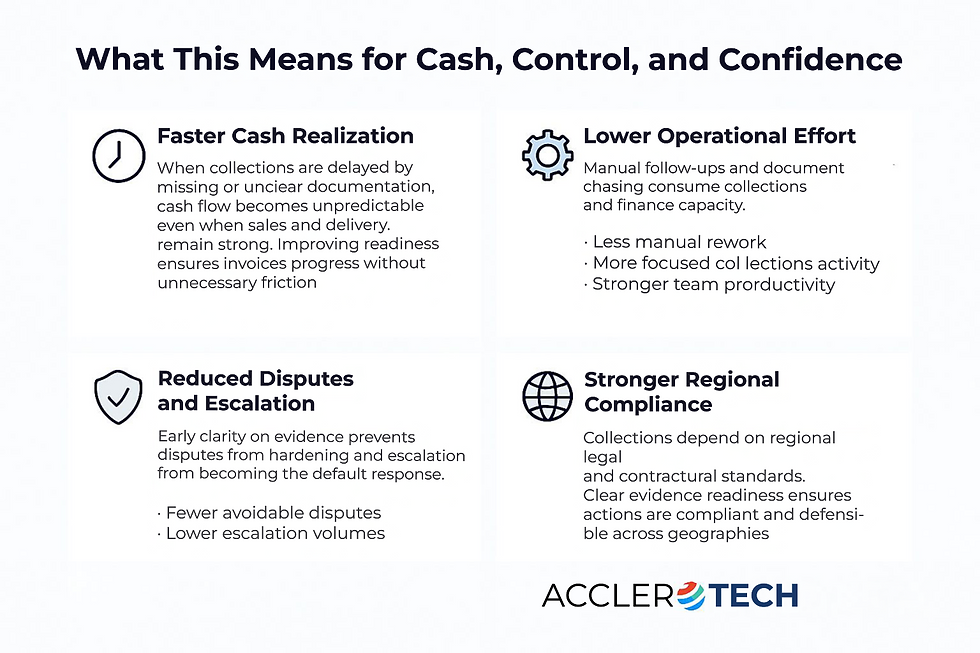
When collections operate without readiness and evidence clarity, the impact compounds quickly:
Higher Days Sales Outstanding (DSO) across regions
Increased manual effort across finance and collections teams
Larger backlog of aging receivables
More frequent legal involvement
Reduced confidence in which revenue is truly recoverable
For a manufacturer with $100M in annual receivables, even a 5‑day increase in DSO can tie up millions in working capital—capital that could otherwise fund operations or growth.
The Shift: From Chasing Payments to Managing Readiness
Effective collections today are not driven by volume of follow‑ups.
They are driven by readiness.
Before an invoice is chased, organizations must know:
Is the documentation complete?
Are contractual conditions satisfied?
Are regional legal requirements met?
Is this case defensible if escalated?
This requires intelligence that sits above transactional systems—not more reminders.
Acting Early to Prevent Dispute Escalation
Disputes rarely escalate suddenly; they harden over time when documentation gaps and ambiguities go unaddressed.
Early visibility into evidence readiness allows teams to intervene while issues are still manageable, resolving concerns before they turn into formal disputes or legal escalation.
The Outcome: Predictable Collections, Stronger Cash Flow
By embedding document and evidence intelligence into collections, organizations achieve:
Faster and more predictable recovery
Lower dispute and escalation volumes
Reduced operational effort
Stronger regional compliance
Greater confidence in financial outcomes
In manufacturing, getting paid is not about sending more reminders. It is about being ready to collect and Success does not end with production or invoicing. It ends when value is realized-cleanly, compliantly, and consistently.
Why Acclerotech
At Acclerotech, the focus is not just on technology-but on outcomes.
We help organizations:
Build the sidecar layer without impacting existing SAP investments
Integrate financial, document, and operational data seamlessly
Deploy Agentic AI models tailored to collections and dispute workflows
Design intuitive dashboards and Copilot experiences for business users
Enable end-to-end visibility from invoice to resolution
Our approach is incremental, practical, and aligned to your current architecture. No rip-and-replace. No disruption to core systems. Just a smarter layer that helps your teams make better decisions faster.
For more details, contact us at


Comments